Powder-bed 3D printing
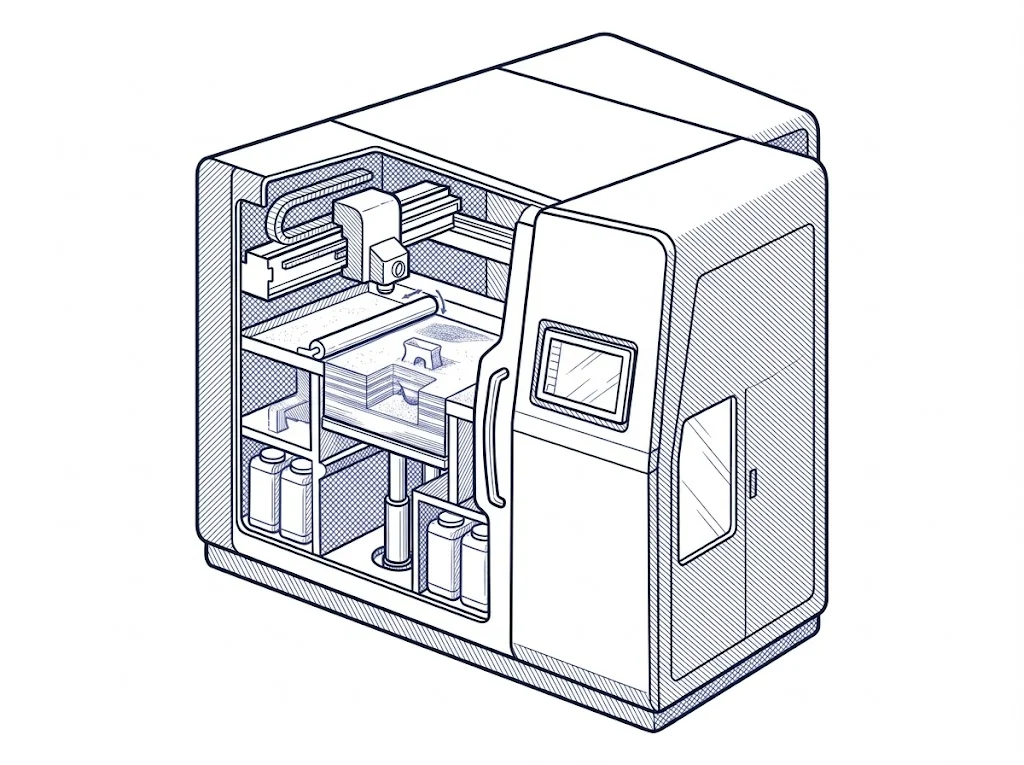
Powder-bed 3D printing groups together technologies that use a bed of polymeric or metallic powder as the starting material, selectively consolidating it layer by layer through thermal or chemical energy. The two main technologies in the polymer segment are SLS (Selective Laser Sintering), which fuses particles with a CO₂ laser, and MJF (HP's Multi Jet Fusion), which deposits chemical agents activated by an infrared lamp for faster and more uniform production.
The defining advantage over other additive technologies is the complete absence of support structures: the surrounding unsintered powder supports the part during printing, freeing design entirely from orientation constraints and enabling internal geometries, snap-fits and moving parts assembled in a single cycle. The most common materials are Nylons (PA12, PA11), flexible TPU and glass-fibre-loaded composites, with mechanical properties suited to functional and end-use parts.
The main limitations are the high cost of machines — which positions this technology primarily in professional and service-bureau environments — and the granular surface finish typical of the process, which usually requires post-processing by sandblasting or tumbling. Recovery and recycling of unsintered powder adds management complexity but significantly reduces material waste.
Machines for this process
No sheets published here yet.
We're verifying the first machines for this process. In the meantime you can browse the whole catalog →