Rolling mill
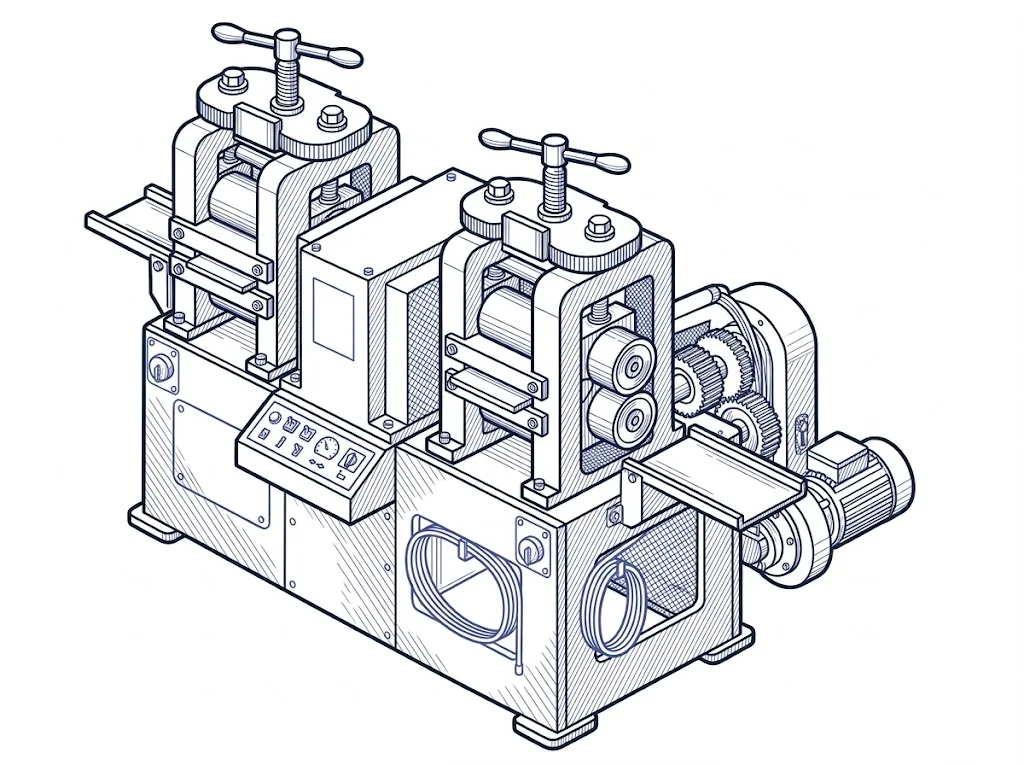
Rolling mills are machines that compress and reduce the thickness of a material — metal, polymer or ceramic paste — by passing it between two or more opposing rotating cylinders. The principle is progressive plastic deformation: with each pass the material thins and elongates, maintaining structural continuity. Rolling can be carried out hot (above the recrystallization temperature) for large reductions with low force, or cold to achieve precise dimensional tolerances and high-quality surfaces.
In industrial settings, rolling mills produce sheets, strips, bars and sections starting from billets of steel, aluminium or copper. In the maker and craft context, bench rolling mills are fundamental tools for goldsmithing and jewellery making: they reduce ingots or sheets of precious metal to precisely controlled thicknesses, enabling the production of wire, sheet for low-relief work and components for technical jewellery. Adjusting the gap between the rolls is the main control parameter, to be carried out gradually to avoid cracking or excessive work hardening.
Machines for this process
No sheets published here yet.
We're verifying the first machines for this process. In the meantime you can browse the whole catalog →