A1 vs H2D
Technical comparison · Fused filament fabrication (FFF/FDM)
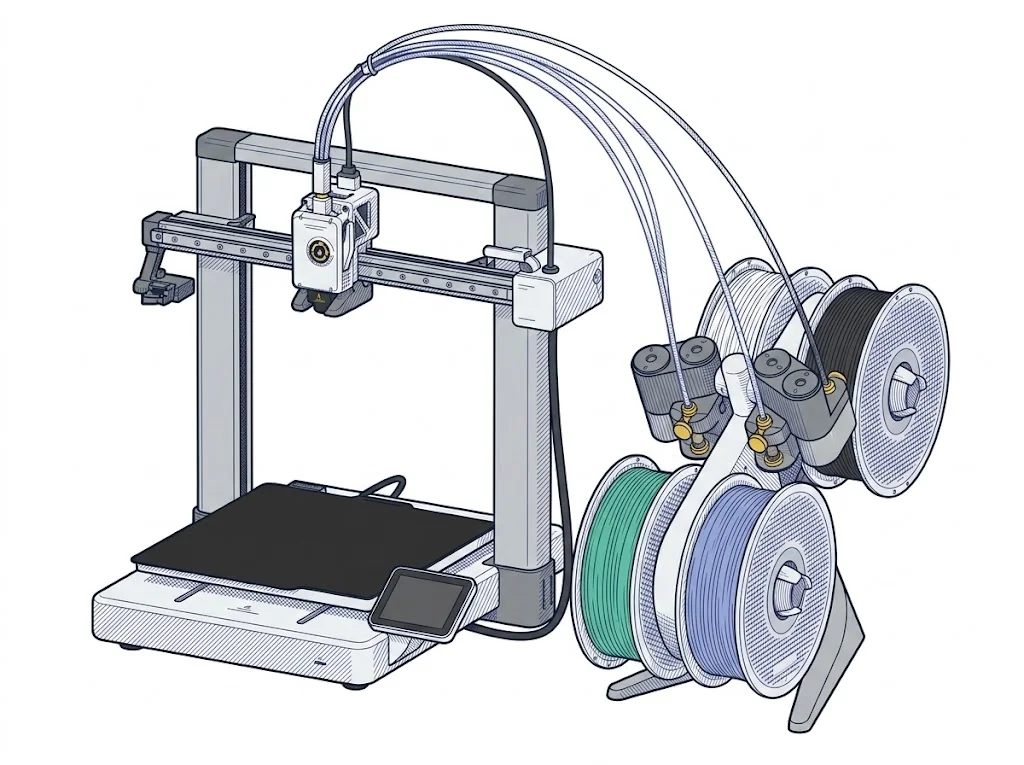
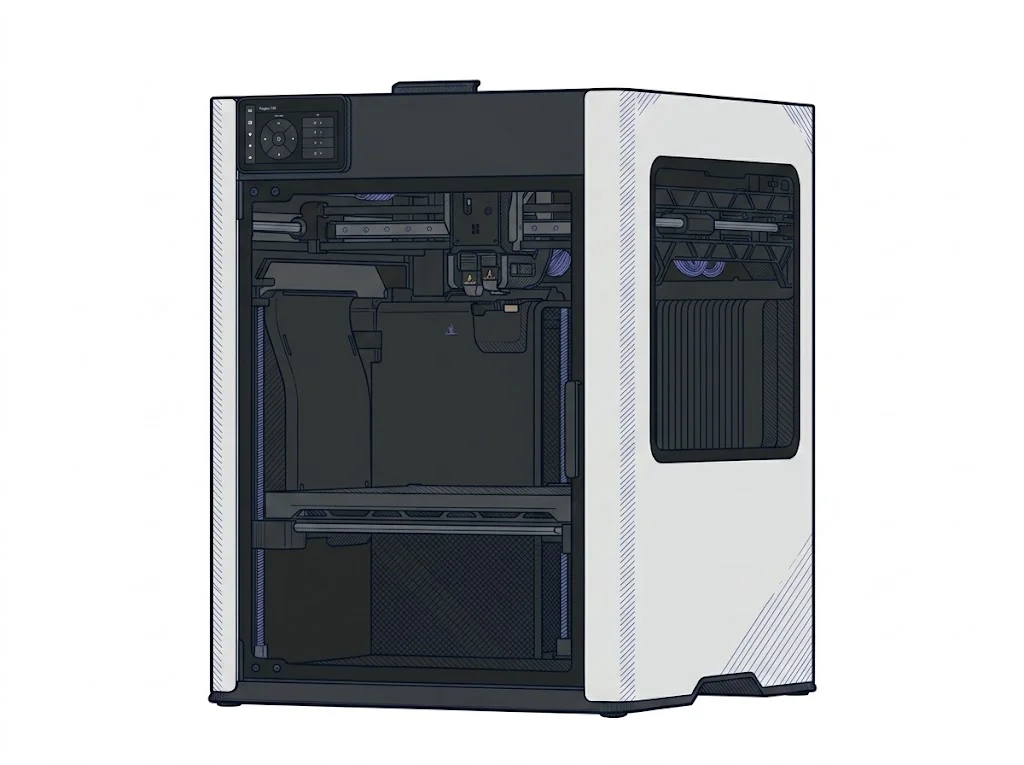
Choose Bambu Lab A1 if you are looking for an affordable and compact open Cartesian printer for the intermediate tier, with a 256×256×256 mm volume. Choose Bambu Lab H2D if you need an advanced-tier machine with CoreXY mechanics, a closed chamber, multi-extruder, and a work volume up to 350×320×325 mm.
| Parameter |
 A1
Bambu Lab
F2 · Intermediate
A1
Bambu Lab
F2 · Intermediate
|
 H2D
Bambu Lab
F3 · Advanced
H2D
Bambu Lab
F3 · Advanced
|
|---|---|---|
| Identity | ||
| Launch year | 2023 | 2025 |
| Use tier | F2 — Intermediate | F3 — Advanced |
| Price | ||
| Price (€) | 429 € | 1899 € |
| Universal specs | ||
| Dimensions (W×D×H) (cm) | 38.5 × 41 × 43 cm | 49.2 × 51.4 × 62.6 cm |
| Weight (kg) | 8.3 kg | 31 kg |
| Work area (mm) | 256 × 256 mm | 350 × 320 mm |
| Z-axis height (mm) | 256 mm | 325 mm |
| Power (W) | 1300 W | 2200 W |
| Voltage (V) | 220 V | — |
| Maximum speed | 500 mm/s | 1000 mm/s |
| Declared precision | — | 50 μm |
| Category specs | ||
| XY print surface (mm) | 256 mm | 492 mm |
| Maximum Z height (mm) | 256 mm | 325 mm |
| Kinematics | cartesian | corexy |
| Max nozzle temperature (°C) | 300 °C | 350 °C |
| Max bed temperature (°C) | 100 °C | 120 °C |
| Max print speed (mm/s) | 500 mm/s | 600 mm/s |
| Closed chamber | False | True |
| Filament sensor | True | True |
| Auto leveling | mesh | mesh |
| Standard nozzle diameter (mm) | 0.4 mm | 0.4 mm |
| Multi-extruder | False | True |
| Native Klipper | False | False |
| Input shaper | True | True |
| Multicolor printing | True | True |
| Requires external accessory | True | True |
| Maximum colors | 4 | 4 |
| Ecosystem | ||
| Cloud dependency | No | No |
| Software notes | The A1 works natively with Bambu Studio, Bambu Lab's proprietary slicer available for Windows and macOS, which handles slicing, automatic calibrations, and remote monitoring via the Bambu Handy app. Third-party slicers — including PrusaSlicer, SuperSlicer, and Ultimaker Cura — are supported via standard G-code export, but advanced features such as vibration compensation and active flow control are only available within the Bambu ecosystem. | The H2D uses Bambu Studio as its official slicer, available for macOS and Windows. Third-party slicers that export standard G-code — including PrusaSlicer, SuperSlicer and Cura — are also compatible, though certain advanced proprietary features (such as automatic dual-nozzle offset calibration and Material CodeSync) are only accessible within the Bambu ecosystem. Remote monitoring and control are handled via Bambu Handy; Bambu Suite manages laser engraving and cutting workflows. |
The differences that matter
- Structure and Kinematics: The A1 uses open Cartesian kinematics, whereas the H2D features a CoreXY structure with a protective closed chamber.
- Print Volume: The H2D offers a work area of 350×320×325 mm, which is significantly larger than the A1's 256×256×256 mm space.
- Extrusion and Ecosystem: The H2D is equipped with an integrated multi-extruder for advanced calibrations (absent in the A1) and reaches higher nozzle temperatures (350 °C vs. 300 °C).
- Dimensions and Weight: The A1 weighs only 8.3 kg and is compact (38.5×41×43 cm), while the H2D weighs 31 kg (49.2×51.4×62.6 cm) to support its larger area and power (2200 W vs. 1300 W).
- Positioning: The A1 (€429) sits in the intermediate F2 tier, while the H2D (€1899) is in the advanced F3 tier with maximum hardware speeds declared up to 1000 mm/s.
Which one to choose
Choose A1 if…
The Bambu Lab A1 (€429) is aimed at intermediate users who require a compact system (8.3 kg) with an open Cartesian structure. It offers maximum temperatures of 300 °C for the nozzle and 100 °C for the print bed, making it suitable for standard operations within its 256×256×256 mm build volume.
Choose H2D if…
The Bambu Lab H2D (€1899) is positioned in the advanced tier, integrating enclosed CoreXY kinematics and a multi-extruder system. Its higher operating temperatures (350 °C nozzle, 120 °C bed) and declared precision of 50 μm, combined with a 2200 W power draw, support complex tasks on a 350×320×325 mm work area.
MakerSpecs is an independent atlas. We don't sell products: this comparison links to both sheets, where you'll find complete data and official links.